
Imagine it’s the eve of an auspicious occasion, and you have thoroughly cleaned your entire residence. You have cleaned your drawing room, bedroom, kitchen, attic, and garage, and now you have a pile of trash that includes discarded batteries, broken toys, old clothes, paper items, broken furniture, and more. At this point, you either resell it or leave it for the collectors to pick up. But in actual it is triggering multiple geopolitical events globally. Countries are fighting over trash to determine ownership and the right to possess it.
The Waste Trade: History of Trashes
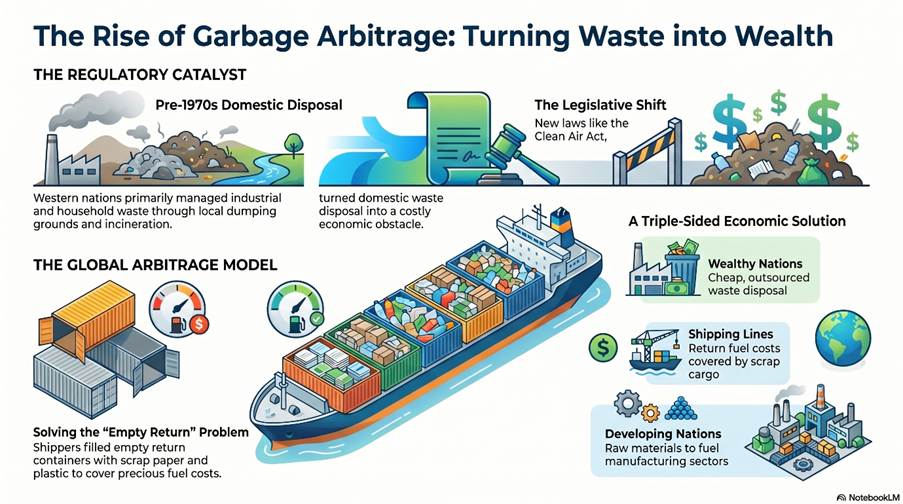
Before the 1970s, the western domain, particularly America and the EU, used to handle trash domestically either by dumping the trash in the dumping ground or by incinerating the trash, most of the industrial and household waste. As this method was viable, these practices continued for decades, but it was also one of the largest reasons for the pollution in the western region. As the social awareness, education and income level arouse to new unprecedented heights, the citizens of these societies started to demand for cleaner environment and in the form of basic rights that a citizen should have and to appease this audience their respected government various laws such as Clean air act and RCR act in US and for EU it was First Environmental Action Program and Waste Framework Directives before the 1970s.
The public upheld these laws, but for the economy, they were seen as an obstacle and a force that was unviable in nature. To counter this, various industries came together and used cost minimization theory and have given birth to a new industry known as “Garbage Arbitrage.” In the mid 1970s western region has started imported cheap and mass produce goods, were once the cargo is dropped on to the ports of western countries they find one of the difficulty which was of sailing back empty handed, which simply means wasting of precious fuel and resulting in increased cost, To solve this, they filled those empty containers with cheap, low-grade plastic scrap, paper, and metal waste. This “garbage arbitrage” meant wealthy nations got cheap disposal, shipping lines covered their return fuel costs, and developing nations got raw materials to fuel their booming manufacturing sectors.
Scandal
In the beginning, “Garbage Arbitrage” was frequently projected as a respectable commercial practice under the guise of partnerships in trade and recycling. The late 1980s, however, revealed a far more sinister reality and marked a sea change in the world’s understanding of toxic waste disposal. The Khian Sea Crisis of 1986, in which a cargo ship from Philadelphia carrying around 14,000 tons of toxic incinerator ash roamed the world’s waterways for almost two years because no nation would accept its dangerous cargo, is among the most notorious examples. About 4,000 tons of rubbish were unlawfully dumped on a Haitian beach in 1988 after the crew mislabelled it as fertilizer. The remaining debris was thrown into the Indian ocean and Atlantic ocean under false pretences. At about the same time, the Koko Incident has also occurred in Nigeria, which has exposed how Italian businessmen paid a local farmer a small monthly fee to store thousands of barrels of radioactive and toxic industrial waste on his property while disguising them as construction materials. Global anger erupted over environmental injustice was aroused by these incidents, which revealed the exploitation of less developed countries.
Protection
The international community was compelled to act after the startling toxic waste crises of the 1980s caused widespread indignation. In response, the United Nations drafted the Basel Convention in 1989, which was the first significant international agreement created especially to control the cross-border transportation of hazardous waste. The main objective of this was to stop rich countries from using developing nations as inexpensive places to dump hazardous garbage. Prior Informed Consent (PIC), a fundamental part of the treaty, which mandates that exporting nations seek express written consent from the receiving country before any transfer of hazardous waste. This was a big step in the direction of environmental justice and increased responsibility for waste management worldwide.
New sponge
While other countries were protected form this toxic waste, China had adopted a completely different approach, you see, China joined the WTO in Dec 2001, but before joining the WTO, China was facing difficulties in importing the critical raw material for the its manufacturing industry, either availability was on difficult terms or was on high price and to solve this China decide in 1992 it will import trash of other countries and extract the required material from it, which resulted in concentration of garbage arbitrage towards China, Between 1992 and 2018, China imported over 106 million metric tons of plastic waste, processing roughly 45% to 50% of the entire world’s discarded scrap.
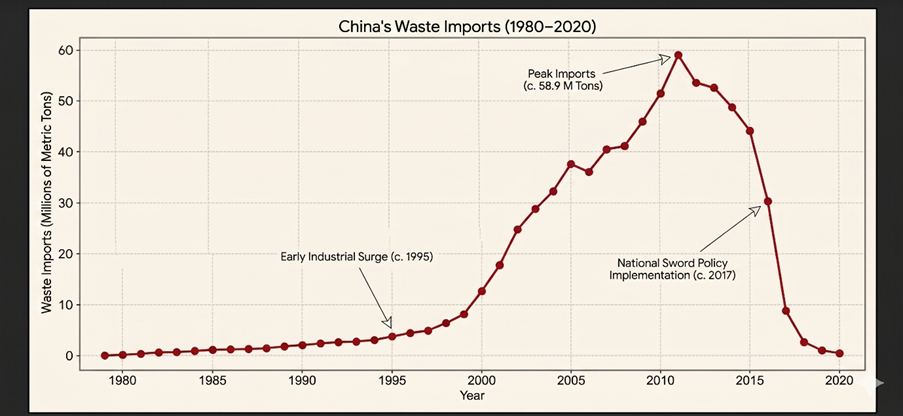
But after 2018, things have taken a 1990 route when China banned the import of trash into its territory
Point of change new geopolitics
In mid-2017, China started its crackdown on the garbage arbitrage industry locally, which impacted the Western garbage arbitrage industry. In July 2017, China told the WTO it wants to ban the import of foreign solid waste. They banned the import of 24 categories of waste, imposed a restriction of 0.5% of contamination limit for the remaining categories, and squeezed the quota for recycling industries of their import share, and China did all of this under a policy known as “Operation national Sword”, It caused an immediate crisis in global waste management resulting in a displacing estimated 111 million metric tons of plastic waste worldwide, and marked the end of China serving as the world’s primary dumping ground.
But the very impending question is, why did China stop the import? The official reason given by China was to protect the environment and establish its sovereignty as an independent nation but the geoeconomic reason was very simple that it had achieved its objective, China has secured its supply chain from mines directly to its factory and from their to international markets, China has acquired mines in South America, Technology from Korea, Japan, and Europe, it purpose for imports has vanished within 3 decades.
Suffering for others
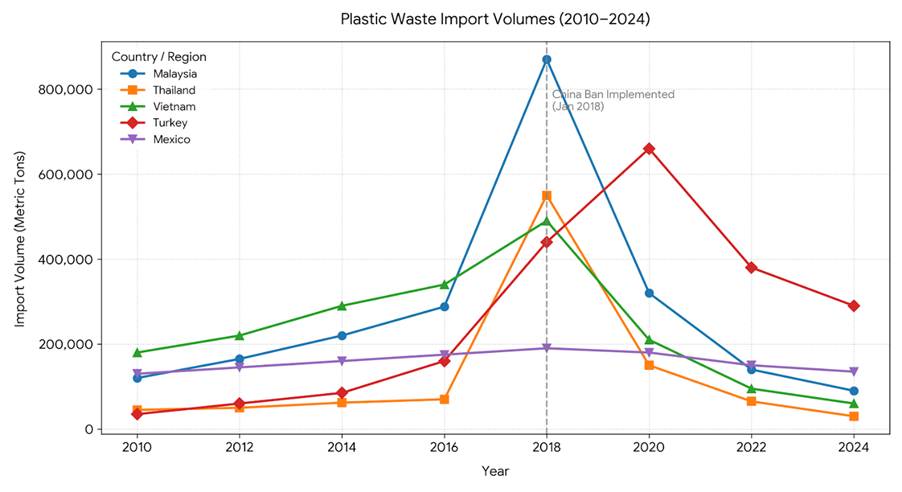
When China implemented its national sword policy and set out to purge this whole trash-importing economy, the Western trash cartel felt the pressure that they could not dispose of the trash in China, and to counter it, they moved towards other dumping grounds, which were primarily China’s neighbors, the ASEAN countries, Global garbage flows were quickly diverted toward Southeast Asia following China’s 2018 restriction on the import of plastic waste, making nations like Malaysia, Thailand, Vietnam, and Indonesia the new front lines of the recycling disaster. Between 2018 and 2020, Malaysia emerged as the world’s top destination for imported plastic garbage, while imports of plastic waste increased by an astounding 1,000% in Thailand. Investigations in Indonesia revealed that up to 30% of imported paper scrap was contaminated with illegal plastic, overloading local recycling processes and putting people at serious risk for health and the environment.
Exporters and garbage brokers created ever-more-advanced strategies to maintain the trade as countries in Southeast Asia started to tighten rules and limit rubbish imports. A method known as “trash laundering” involved rerouting large amounts of waste through intermediary ports, where shipments were repackaged and relabelled to hide their actual origin. By categorizing mixed garbage as Refuse-Derived Fuel (RDF) or alternative fuel for industrial use, other exporters were able to get around import limitations on plastic. At the same time, waste flows moved geographically toward nations that are closer to important consumer markets. Mexico became a major entry point for waste coming from the United States, while Turkey became the main destination for Europe. By 2019-2020, recipient nations’ dissatisfaction had escalated into diplomatic disputes. Waste trade became a major geopolitical and diplomatic issue when Malaysia and Indonesia seized and returned hundreds of illegal waste containers to nations like the United States, United Kingdom, Australia, and France, while the Philippines demanded the return of 69 containers of mislabelled Canadian waste.
Why did trash step again?
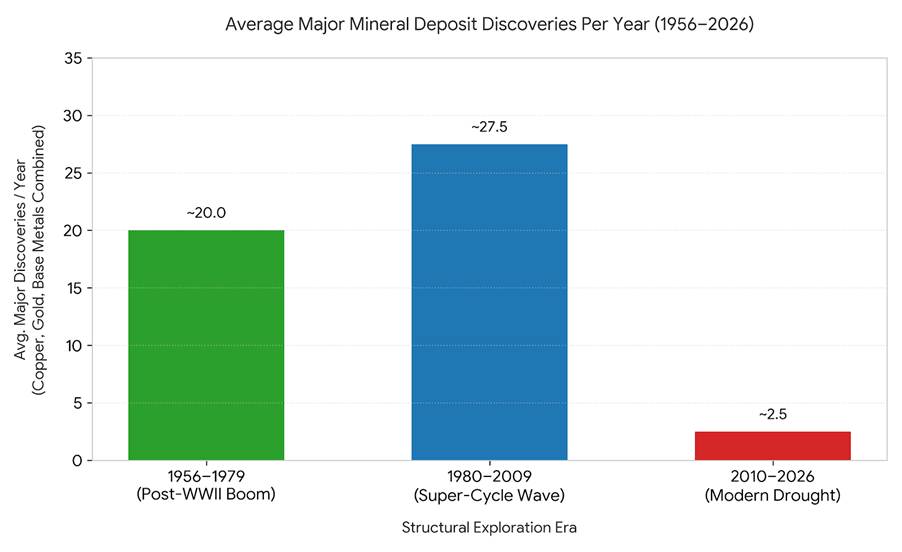
Now we know that trash and recycling have a geopolitical and economic history that saw its tussle for nearly half a century, but why are we talking about a dead raccoon again? The reason is natural, which is Artificial Intelligence. Then demand side of the metal, chemicals, plastic and other core manufacturing products, you see AI industry is not just limited to a normal LLM language it has wide spread of its wing which includes, AI data centers, AI Chipset, AI robots, and AI enabled machines has triggered a tide of demand which was unprecedented in the human history and we are simple not able to meet the demand of it, but same question comes again, why so? The simple answer is a lack of mines for metal.
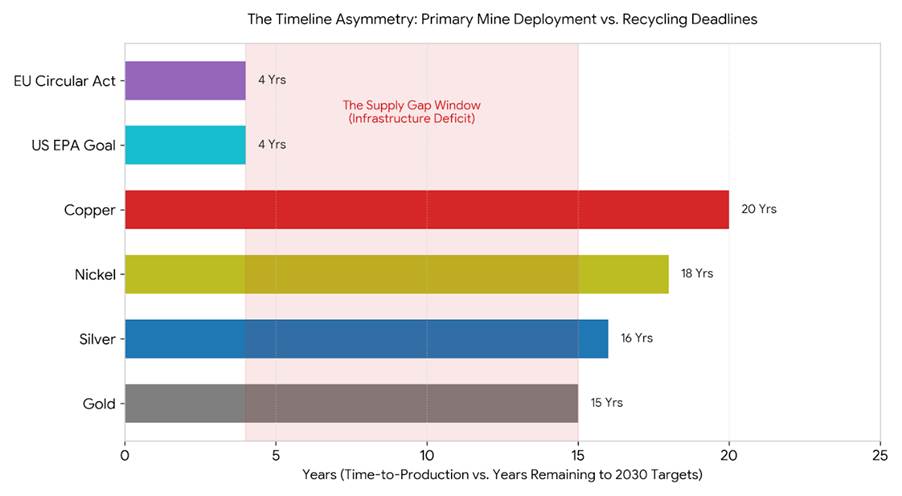
Globally, it takes 15 to 24+ years to bring a new mining discovery into active production, which is a drawn-out and expensive procedure. Due to diminishing ore grades and the extensive infrastructure required to mine low-grade rock, copper has the longest development period, ranging from 17 to 24 years. Due to the complicated engineering and stringent permits needed to build sophisticated chemical processing facilities, nickel comes in second at 16 to 18 years. Gold, on the other hand, moves the fastest at 15 to 20 years, since, once an economic deposit is obtained, its processing footprint is significantly less infrastructure-intensive. Since more than 70% of silver is a by-product, its timing typically hinges on the larger copper or lead-zinc projects to which it is geologically linked. For principal mines, silver tracks similarly at 15 to 18 years. Finally, because of its geographic concentration in complicated jurisdictions like South Africa, palladium has the greatest entrance barriers, ranging from 18 to 22 years. To safely access the ore, developers must spend years excavating some of the world’s deepest underground mines.
China’s control
We are aware of one thing for sure: the trash we are talking about includes paper, plastic, metals, and chemicals, which have served their primary purpose and are of no use for now, but the supply chain details will help us better understand how China severely influences the AI race by countries. China is the world’s largest extractor and consumer of minerals, which includes oil, gas, coal, gold, silver, and all other industrial metals, and this is biggest reason out off of multiple reasons for making trash a geoeconomic tool.
You see China’s core mining sector is valued at approximately US$ 354.3 billion. To put its sheer physical output volume into perspective, the country produces over 5.34 billion metric tons of minerals annually. This includes dominant global extraction volumes across critical industries. While a 3% direct GDP contribution sounds modest on paper, the mining sector’s true contribution to China’s economic health is vastly larger because it dictates the survival of its industrial supply chain. The rapid development of China’s modern agentic AI infrastructure, data center networks, military defense frameworks, and clean energy tech (like its surging EV sector) has created an intensely rigid reliance on domestic critical mineral mining.
The dominance is not only in processing it is also in processing To fully grasp the industrial scale of China’s processing facilities, look at its percentage shares of global tech-grade refining: In Heavy Rare Earths 99% of global processing, In Total Rare Earth Elements 90% of global mine-to-metal refining, In Graphite 80% of global battery-anode grade processing, In Cobalt 68% of global refinery output, In Lithium & Nickel 60% to 65% of global battery-grade chemical conversion capacity.
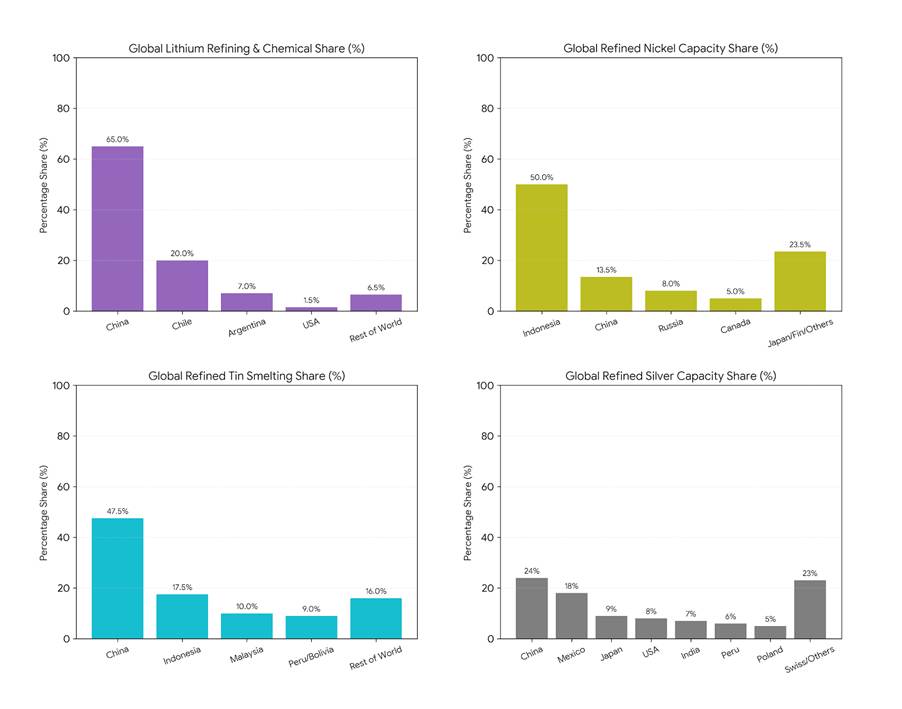
These details are only for the metal sector; we have not taken even a glimpse of the petrochemical sector of China, which has a ginormous share in global fuel production, API production, supports different grades of plastic production, fertilizers and pesticides production, textile chemicals, and other important resources and this centralization of resources and its processing is causing the West to panic and look for trash.
Global Panic
Confronted by the hard reality of a 20-year timeline to dig a new hole in the ground, governments have stopped viewing the blue recycling bin as a chore and started viewing it as a strategic reservoir. The race to decouple from traditional mining and Western vulnerabilities has sparked a wave of aggressive domestic “Trash Policies” designed to legally mandate the extraction of manufacturing feedstocks from our own waste streams.
In the United States, the strategy centres on transforming a fragmented domestic system into a unified engine of supply. The Environmental Protection Agency is executing a National Recycling Strategy aligned with a strict mandate to push the American recycling rate to 50 percent by 2030. Realizing that the current infrastructure is leaking valuable material, federal assessments indicate a required investment of $36.5 billion to $43.4 billion by 2030 to modernize materials recovery facilities and optimize curb side collection. This overhaul is projected to recapture an additional 82 to 89 million tons of packaging and organic commodities. Simultaneously, Washington has targeted high-value tech waste, injecting hundreds of millions of dollars specifically into critical mineral and battery recycling infrastructure to ensure that the lithium and cobalt powering the domestic tech transition are harvested from discarded electronics right on American soil.
European Union has also shown a shift in its approach by introducing new environmental encouragement to strict economic enforcement. Driven by the urgent need to secure resource independence, Europe is preparing to adopt its new law, which is the Circular Economy Act. This legislative framework aims to double Europe’s circular material use rate from its current stagnant level of roughly 12% up to a mandatory 24% by 2030. Underpinning this is the EU’s Waste Shipment Regulation, which cuts off the traditional escape hatch by imposing a total ban on plastic waste exports to non-OECD nations. Europe is compelling its industry to change by keeping its waste inside its borders. Even though the Critical Raw Materials Act (CRM Act) requires recycling to account for 25% of Europe’s yearly consumption of strategic minerals by 2030, recovery rates for vital technological elements like rare earths and lithium are now less than 1%. The forthcoming Act is intended to significantly alter market pricing in order to close this gap between supply and demand. It will do this by using tax modifications, lower VAT rates for refurbished goods, and stringent Extended Producer Responsibility regulations to make the extraction of secondary materials less expensive than purchasing virgin inputs.
India’s Lap Just Got Very Heavy
While the west takes tension, India is sitting on something it has not fully named yet, a recycling economy that is already enormous, already skilled, and almost entirely unformalized. That is not a problem statement. That is a starting position.
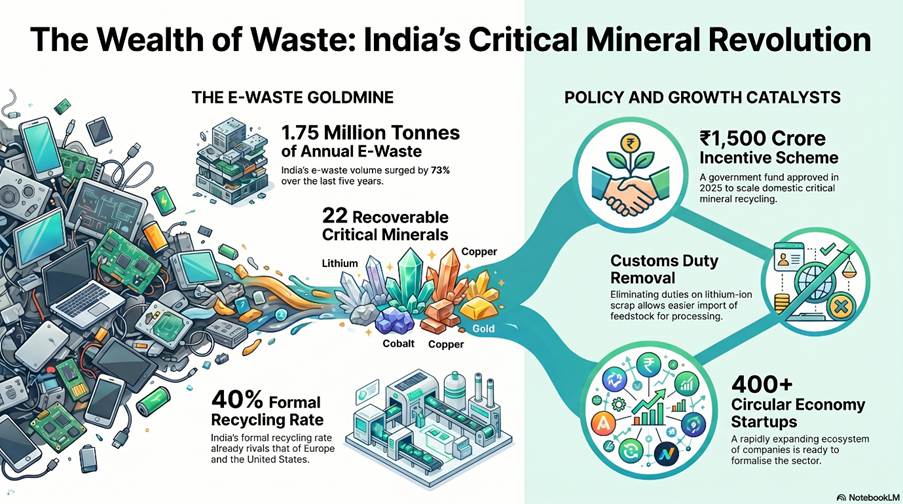
India has generated around 1.75 million tonnes of e-waste in FY 2023 to 24, a 73% rise in just five years. Inside that trash pile mainly includes lithium, cobalt, copper, gold, and at least 22 other recoverable critical minerals, according to Attero Recycling, one of the country’s leading formal processors.
More than 80% of that waste is still processed informally, by workers in open workshops, using acid baths and bare hands, for a daily wage of roughly Rs 300. They are recovering minerals that Europe is now writing legislation to get back. They just are not being paid.
The Indian government has started to move. In September 2025, the Central Government Cabinet had approved a Rs 1,500 crore Incentive Scheme for critical mineral recycling, removing customs duty on lithium-ion battery scrap in the same budget cycle to make imports of spent batteries easier, expanding the feedstock pool for domestic recyclers over the next four to five years.
The arithmetic is straightforward. India already has nearly 400 startups active in the circular economy space, a workforce of millions already doing the dismantling, and a formal recycling rate above 40%, nearly matching Europe and the United States, even before serious capital has arrived.
The West spent decades building mines. India already has the workers, the waste, and the window. The only question is whether it formalizes fast enough to claim what is already in its hands, before someone else builds the infrastructure to process it for them.
Trash will Decide who will be next trash
Go back to where we started, that pile of junk sitting in your garage after a thorough cleaning. Batteries, broken circuits, old wires. You treated it as the end of something. The world has just realized it is the beginning.
What we have traced across this piece is not a story about recycling. It is a story about power. The same logic that once sent warships to protect oil lanes is now being send to scrapyards. In 2026, control fight over critical minerals continues reshaping geopolitical environment, industrial policy, and national security policy and these critical materials are central to the energy transition, digital infrastructure, and defense capabilities.
In October 2025, JPMorgan Chase announced a $1.5 trillion, 10-year Security and Resiliency Initiative, pledging up to $10 billion in direct equity and venture investments in companies tied to national security, specificaly including those companies that are involved in critical mineral critical minerals and battery supply chains. When the largest bank in the world starts treating recycling as a national security investment, the signal is impossible to misread.
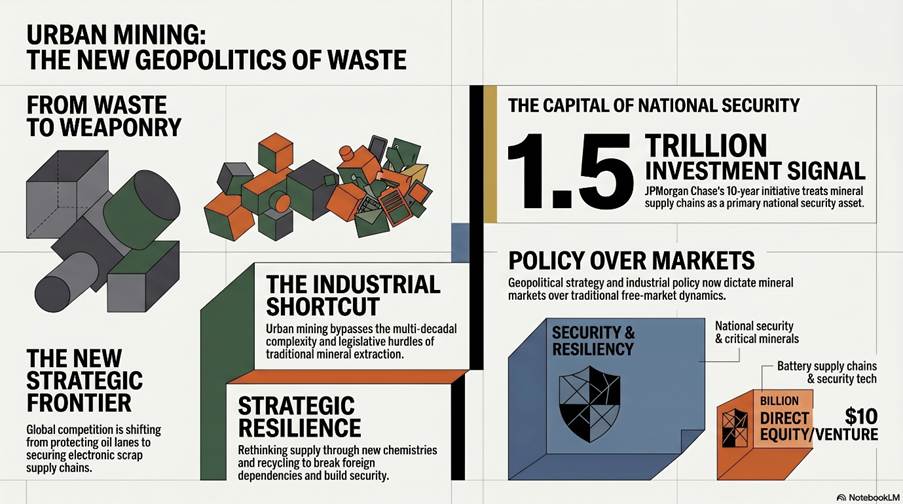
Morgan Bazilian, director of the Payne Institute at the Colorado School of Mines, put the underlying problem plainly: “The reality is that mining is complex and difficult”, a multi-decadal situation that no government can legislate away. That is the main reason why trash has become the shortcut every major economy is now racing toward.
The real challenge is not just securing more minerals but rethinking supply chain itself by investing in recycling, urban mining (trash collecting), R&D to break dependencies and build resilience. Rather than free-market dynamics, we are entering an era where industrial policy and geopolitical strategy dictate the future of critical minerals markets.
The Khian Sea drifted for two years because nobody wanted its trash. Today, nations are writing billion-dollar legislation to hold onto theirs. That is not irony. That is how power shifts quietly, in containers, one discarded battery at a time.
