
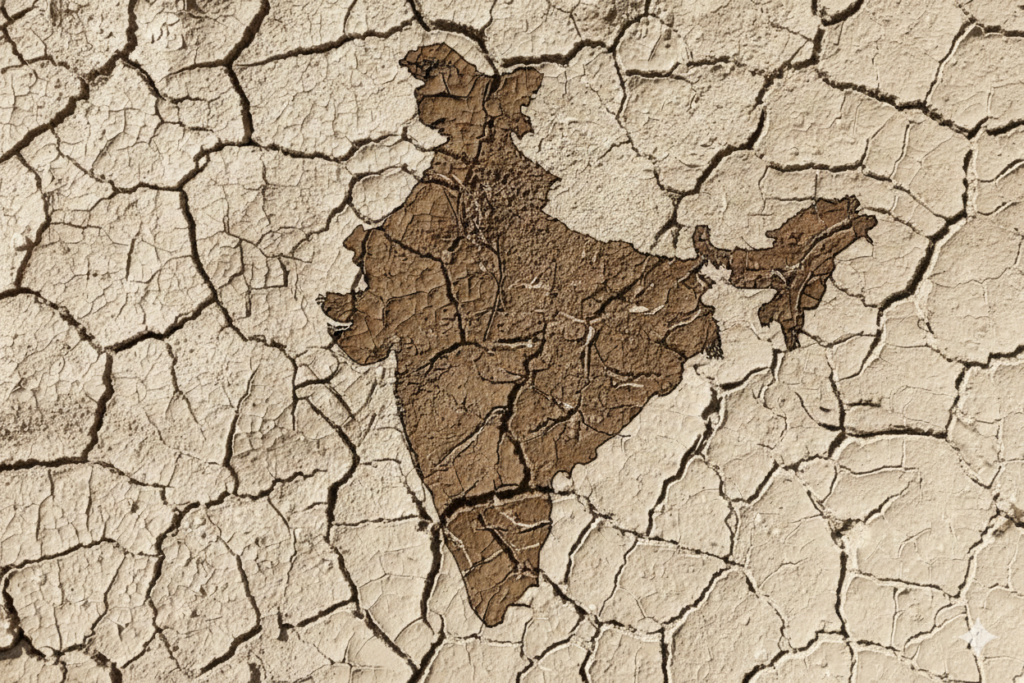

“Apo hi shtha mayo bhuva sthana o orje dadhatana | Mahe ranaaya chakshase ||” (Rigveda 10.9.1), Meaning: O Waters, you are indeed sources of joy and bestowers of Vigor; grant us health and strength. The above-mentioned Rigveda Shlok is not some random words, this is the mindset of Indians that they have held for more than 4000 years, In India water is regarded as a highly divine existence and from ancient times Indians has worshipped the water bodies in the form of deities who has descended from cosmos to the planet earth for wellbeing of all the living being on the earth, but in the 21st centuries these values and beliefs are being washed away by the desire to have high living standards in exchange of nature most profound blessing water.
Real-Time Collapse of India’s Water Security
India houses nearly 18% of the world’s population, but it only possesses 4% of the world’s renewable freshwater resources. Whenever we decide to achieve something in the future, we do a basic thing in our present, which is to assess our current standing and measure the difference between our current strength and future requirement, and India is no different in terms of following this concept. India must first assess its current water situation to design futuristic solutions.
Water Availability
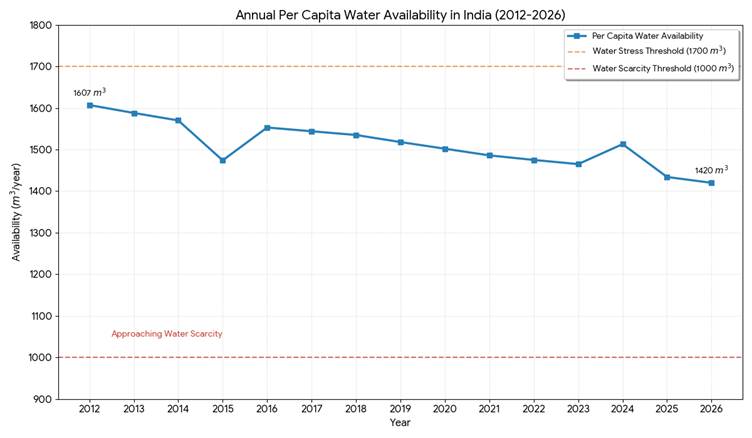
According to Indian government own data India water availability per-capita was around 1500 cubic meter in 2021, which is expected to go below 1350 cubic meter in 2031, and according to the international criteria by World bank, UN and Niti Ayog India is moving towards from water stressed country to Water scarcity state which is clearly opposite position from 1951 where India was a No water stressed state with more than 5000 cubic meter.
India’s global ranking in terms of water availability per capita is 133rd out of 182 countries, and the global average per capita is more than 6000 cubic meters, which clearly shows how deficient and scarce the present amount of water is for India.
Water Contamination
In India, approximately 70% of surface water is contaminated, with the contamination affecting around 440 districts all over India. The toxicity of water ranges from nitrate to arsenic, and it originates from the rural heartland of India, industrial pollutants, and agricultural chemicals and waste, all of which play a major role in contaminating surface water and ultimately seeping into underground waters.
The ranking is not only bad in the availability of water, but its performance in the water quality ranking is also poor. In terms of ranking, India ranks 120th out of 122 countries. It is estimated that around 200K death results just because of contaminated water.
Himalayan Echo
In India and the Indian sub-continent, Himalayan glaciers play a crucial role, around 1.9 billion people depend upon the Himalayan rivers’ water, according to a UN report. The Himalaya is melting 65% faster in the decade from 2010 compared to the decade from 2000. The glaciers play a crucial role in filling up the water bodies in the Indo-Gangetic plain, and those bodies help to produce 50% of the food in the Indian sub-continent.
Monsoon Drops
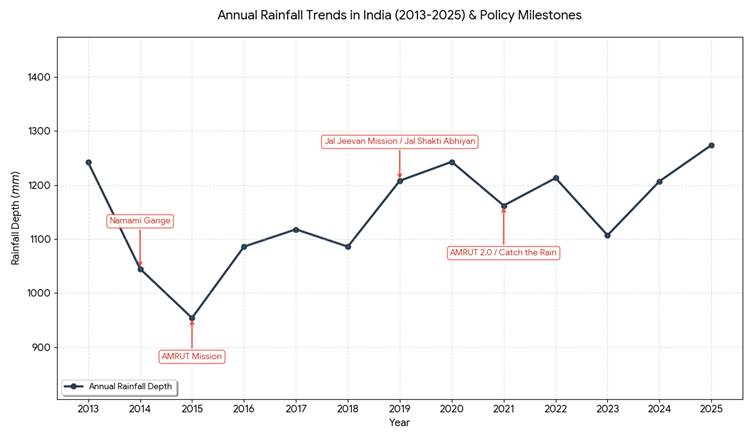
India’s 2026 water crisis extends far beyond El Niño. A negative IOD is diverting monsoon moisture, causing a 15 to 20% seasonal rainfall deficit, while atmospheric brown clouds reduce precipitation by nearly 10%. Rainfall has become extreme, with a 43% rise in intensity, limiting recharge. The loss of 2.3 million hectares of forest since 2001 has damaged the evapotranspiration loop, eliminating 25% recycled rainfall, leaving India climatically wet but hydrologically bankrupt.
The basement is getting Empty
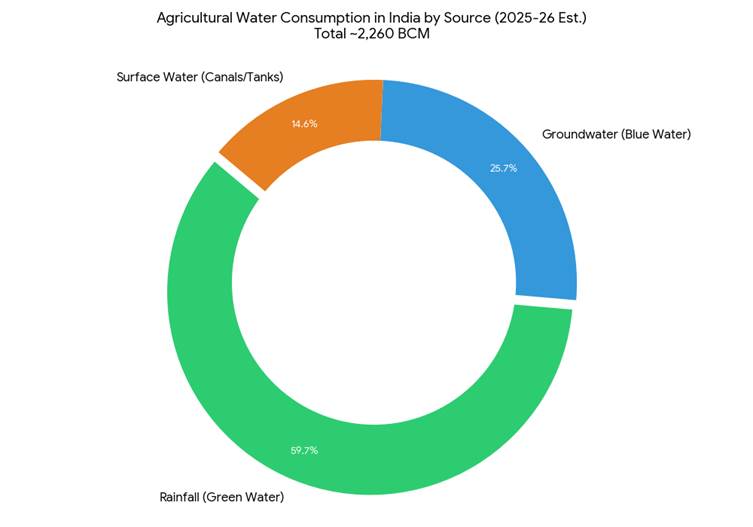
Groundwater exhaustion lies at the heart of India’s water scarcity. Nearly 65% to 70% of irrigation and over 85% of rural drinking water depend on groundwater, yet India extracts almost 25% of global groundwater, more than the US and China combined. Over 1000 assessment blocks are over-exploited, with water tables falling 0.5 to 1 metre annually across major farm belts. Annual extraction now exceeds natural recharge by a whopping number of 60 billion cubic metres, turning aquifers into non-renewable reserves and deepening water insecurity even in normal monsoon years.
Downstream Effects: Costs of Water Scarcity
The effect of water shortage or not only results in the thirst of future generations, but it also has a cascading effect, where one can say water is the economic and political tool that is used to fuel the views, narrative, and actions, and any mismanagement of water as a resource weakens one’s stand at the global level and makes sure that even being capable of reaching the moon, the water deficit country should not be able to produce the staple foods.
There are various effects of water shortage on a country, from the local to geopolitical level, but one thing is certain: “it is negative in nature.”
Crops, Calories, and Collapse
India’s agriculture sector alone is responsible for around 85% of the freshwater consumption, and employs nearly 45% employable population; these numbers are pulling more number compare to the US and China, we use 2 to 3 times more water to grow 1 ton of crop compared to the global average, if this trend continue than India might soon run out of fresh water. They must opt for the strategy that they have selected for pulses, they must farm on foreign soil and export from there to their homeland.
Water as a Production Bottleneck, Not an Input
From an industrial perspective, water consumption is relatively low compared to agriculture, accounting for 8% to 9% of total water usage. However, certain industries face a direct threat due to this water scarcity, such as the textile, FMCG, and Chemical sectors, which consume approximately 4% of their operations’ water. The industries’ direct consumption is surely not high. Still, their indirect consumption is astronomical, as their supply chain consumes a significant amount of water daily, like a thermal power plant, which generates 70% of India’s total electricity and consumes nearly 8% of the total water consumption.
Companies are now forced to invest billions in Zero Liquid Discharge (ZLD) technologies just to stay operational, turning water management into a survival-of-the-fittest race for India’s industrial giants.
Silicon & Scarcity
The heat generated by the modern-day industry is not limited to the economy, it expands to the 75% earth surface. In the world of Gen AI, for every 100 words, it consumes 500 ml of water for cooling, for server cooling purpose and requirements gets even larger in the case of data centres where a large scale data centres drink more than 5 million gallons of water, which is around 30000 people daily, the situation for semiconductors is even worse as it requires up to 10 million gallons of Ultrapure Water (UPW) every day to rinse silicon wafers.
India’s Union Budget 2026 has allocated massive capital for “Silicon India.” The infrastructure for Water Circularity (recycling 98% of industrial water) is currently the only thing standing between a tech boom and a regional water collapse. If these industries are built in water-stressed states without mandatory Zero Liquid Discharge (ZLD) systems, they will directly compete with local citizens for drinking water.
Concrete Thirst
The Indian urban population is responsible for consumption of 4% of total water consumption in India, and one of the most directly impacted stakeholders might be none other than Urban players, due to the water apartheid urban jungle has given birth to a new underworld which is led by tanker mafia who owns illegal underground storage and deep borewells and supply water at a high rate.
Water scarcity has really played a crucial role in the real estate price decline around 10% to 15% in metros like NCR and Chennai, and those areas specifically designated as water scarcity hotspots.
With around 36% population of India living in urban areas, they had already started facing water scarcity in an installed manner.

Cost of Compromise
Water shortage will surely lead to the adoption of water conservation techniques, and a family only has 20 litres of water for the day, handwashing is the first thing to be sacrificed. Less usage of water could result in sanitation mismanagement. Frequent waterborne infections prevent children from absorbing nutrients, contributing to the 1 in 4 children in India who suffer from chronic stunting.
When pipes are empty, the surrounding groundwater is sucked into the drinking water lines through cracks and corroded joints, and a major waterborne disease could be born out of it.
In states like Rajasthan and Gujarat (Mehsana district), chronic scarcity has forced reliance on high-fluoride water, leading to permanent bone deformities and “bent backs” among rural populations.
Thirst is the New Tourist
Tourism in India is a major economic engine, contributing nearly 9% to the national GDP. As water scarcity becomes the reality of modern India, our most iconic destinations are facing a crisis of reputation and survival.
A typical luxury hotel in India consumes 550 to 600 LPCD in a day, which is roughly around 4 to 5 times more than the average consumption of urban residents, this disparity also triggers protest sometimes in water stressed state, in the early 2026 reports 2were floated that Shimla faced a decline of 15% to 20% in international booking just because concerns over hygiene and water availability in high-altitude luxury camps.
India’s Response Must Be Structural, Not Symbolic
Surrounded by the self-made enemies in the form of policies, urbanites, farm crops, India’s water scarcity truth cannot be voted out, it must be faced and make sure it perishes, and India is not failing at this point as steps by the government in the past decade reflect the intention of Indian that there is recognition of the problem. If India’s water crisis is systemic, then its response cannot be fragmented. The shift must be structural across food systems, infrastructure, ecosystems, cities, and industry, where water is no longer treated as an infinite input but as a strategic national asset.
Replacing Paddy with Resilience
By promoting millets, India is moving away from traditional water glutton crops like rice and paddy, while millets consume 70% less water compared to paddy, they can also grow in arid region, rice, and sugar cane alone consume 60% of total agricultural water demand, if India replace even 20% of its rice field with millets it will save 50 to 60 Billion cubic metres of water.
Government procurement support, inclusion in the Public Distribution System (PDS), and the “International Year of Millets” narrative signal a strategic pivot: aligning food security with water security.

Rooftop to Water Security
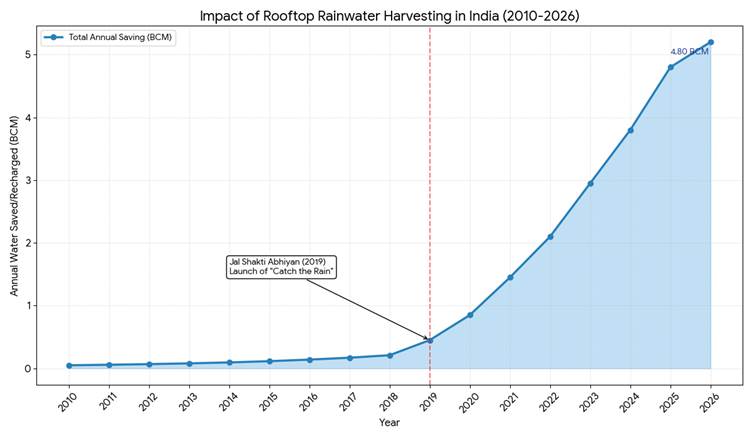
India receives an average rainfall of approximately 1700 ml totalling around 4000 billion cubic metres, but due to a lack of preservation technique, India is facing the deportation of 1200 billion cubic metres towards the sea, and to conserve this, new residential and commercial buildings across 50 major metros are now legally required to install RWH systems. If optimized, urban India can capture up to 15% to 20% of its annual water requirement directly from the sky only.
Traditionally, India was dependent on the local ponds for their main water source, but with the expansion of the industrial base and urban existence, filling up the ponds became a trend. The initiative to revive those ponds became crucial for existences and as of 2026, India has rejuvenated over 75,000 local ponds, creating a decentralized “Water Bank.”
Nature’s Water Pump
Since 2001, India has faced a loss of 2.3 million hectares of forest, which has weakened evapotranspiration, reduced cloud formation, and destabilised local rainfall. To address this issue, India plans to afforest 5 million hectares of land under the National Mission for a Green India. It will ensure that the 25% of local rainfall recycled by trees is returned to the sky, maintaining the delicate balance of our monsoons.
Circular Flow
To make sure that Indian cities be self sufficient in terms of the water requirement Indian government has taken things in his hand and under the Jal Shakti ministry, India has mandated that 20% of the total wastewater generated by cities should be reused by the cities only, Under the AMRUT 2.0 and Swachh Bharat Mission (Urban) 2.0, wastewater is being treated as a high-value commodity, with a focus on supplying recycled water to thermal power plants, construction sites, and urban parklands, effectively freeing up freshwater for drinking.
Cities like Surat and Navi Mumbai are leading the way by treating sewage to tertiary standards and selling it to industrial clusters, turning what was once an environmental cost into a sustainable revenue stream for the municipality.
Invisible Reservoirs
Ground water act as a primary source for the extraction of water for rural daily chores and agricultural purposes. Groundwater contributes nearly 62% of total consumption by the agriculture sector. To ensure the groundwater tank does not run out of water, GOI and the World Bank funded a scheme, “Atal Bhujal Yojana,” to map out and refill the groundwater in the whole of India.
The Indian Rainwater Harvesting Market was valued at approximately $263 million in 2024 and is projected to reach $378 million by 2030, growing at a CAGR of 11.9%. The reason is the Indian government’s investment and focus on the recharge of groundwater.
Macro-Reserve
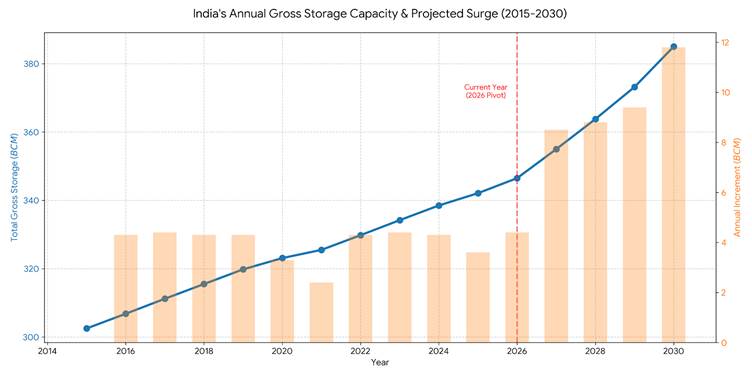
If ponds act as a micro shield, then dams act as a macro shield from water scarcity. The current capacity for the Indian dam’s storage is around 345 BCM, and there are more than 300 small and large dams and reservoir projects that will be completed before 2030, extending the current capacity by 40 BCM to a new high of 385 BCM.
Foreign countries actions
Any analysis which is involving an objective to improve current conditions and reach a parameter or to reach an industry average, you do 2 types of analysis, one is internal analysis, where we measure our actions and try to find what is wrong and right, we have committed, and the other is external analysis where we analyse the competitor action and try to pick useful insights which can improve one self position, and in this section we are goanna do same for India.
We will be recording major national action to tackle the water scarcity technique and how it can be integrated into the Indian system and goals.
Israel: Gold standard for Desalination
Israel and India are known for partnering with guns, and Israel, a desert-surrounded nation, is also known for another thing, which is being tagged as a “Water exporter nation.” Israel treats its water like a strategic national asset, not a free public commodity. Israel implemented 100% smart water meters all over the nation, which made sure that not a single drop gets wasted.
Israel recycles nearly 90% of its wastewater for agricultural purposes. If India can scale its current 28% treatment capacity to match this, we could effectively “create” a new river the size of the Ganges just through recycling.
Singapore: NEWater Loop
Singapore faces somewhat similar challenges to India, which is a “concrete jungle.” Limited land and high population force the nation multiple times to use a single resource at its max, and Singapore did the same with water. Singapore’s solution was “NEWater,” a high-grade reclaimed water that meets drinking standards. Singapore mastered the psychology of recycling. They rebranded “sewage water” into a premium product through massive public awareness campaigns over a period.
India must adopt Singapore’s 4 National Taps strategy, diversifying supply between local catchment, imported water, desalinated water, and highly purified reclaimed water.
UAE: Building in the mountains of Secret
UAE has declared water as an essential commodity and to treat this essential commodity at its highest level, UAE is building strategic reserves for water storage, UAE will be investing $3 billion to build one artificial strategic water storage reserves and another is converting a natural cave into an strategic water reserve and combined storage capacity will exceed 2.6 Billion cubic metre and will act a buffer for 90 days for whole UAE.
Bottom Line of Survivability: ROI on Every Drop
India is standing at the edge of a silent emergency. A nation that feeds 18% of the world’s population with just 4% of global freshwater is now draining available water resources faster than nature and the self can refill them, polluting rivers beyond recovery, and turning monsoons into Russian roulette. Groundwater tables are falling 0.5 to 1 metre every year, forests that recycle 25% of local rainfall are disappearing, and cities are modernizing their economy by using tanker mafia as their raw material.
The cost of inaction is staggering. Agriculture consumes 85% of freshwater, industries are investing billions merely to remain operational, cities are losing 10 to 15% of real estate value, tourism is bleeding reputation, and public health is on risks from fluoride deformities to waterborne epidemics which are rising quietly. Day Zero will not arrive as a new headline, it will unfold neighbourhood by neighbourhood, borewell by borewell.
India still has a narrow window. Water recycling at scale can create a “virtual water source.” Crop realignment can free billions of cubic metres from shackles. Rainfall is not absent, but the management vision is. The difference between survival and scarcity will be decided not by rainfall charts, but by governance, enforcement, and collective restraint.