


For centuries, global trade routes have served as the arteries of human civilization, circulating not just goods, but also the ideas and wealth that fuel the world’s economic engines and drive global growth. Whenever this world has faced any choking of trade routes, it has developed a new one. History can vouch for that, when Persian empire imposed a blocked on the silk route from (247 BC – 651 AD), it has developed new route which was Steppe bypass and Red Sea route, an when Ottoman Empire blocked the silk route in 1453 world discovered spice route, and in this modern era the global trade route is also in danger from Suez canal choke to Russia Ukraine war there are “N” number of geopolitical reason where global trade route is in danger, and to counter this modern problem the solution needs to be futuristic and world has it which is IMEC (India Middle-East Europe Economic Corridor), but wait isn’t it already dead?
IMEC: A New Country Road From India to Europe
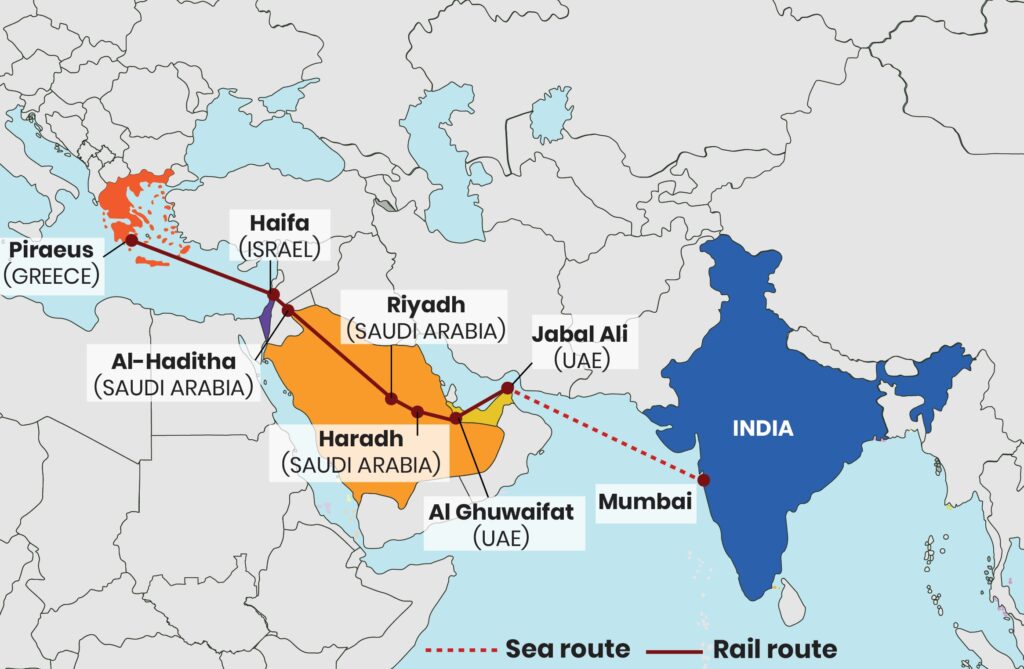
On 9th September 2023, New Delhi announced that a new trade route will be established, which will start from India and end in Greece. At the G-20 World Leaders’ Summit, Indian Prime Minister Narender Modi, US President Joe Biden, and Saudi Arabia Crown Prince Mhd Bin Salman announced together that about this project.
The scope of this project ranges from India to Greece in terms of physical boundary but if you expand you view from physical existence to physical impact then you will realize the scope of project the project includes mode of communication from road to sea, Air space to digital space, physical infrastructure to strengthening social Fabric, IMEC support the requirement $94 Trillion by 2040 with an total investment commitment of $600 billion to $800 Billion from different stakeholder like Gulf Countries, US, Europe, IMEC will decrease the average moment speed by 30% to 40% from India to Europe.
IMEC will transport 20000 cargo containers on an annual basis on its route, and daily, more than 20 trains will be required on the railway route to handle the cargo and move it to another port, The railway route alone will stretch to 300+ kilometers.
The prudent benefits that IMEC will generate will be high-speed connectivity between regional partners, efficient and longer stability in the supply chain, high-speed data as optic fiber play their parts, hydrogen and fossil fuel pipelines ensure energy availability, and IMEC also promotes tourism and cultural exchanges between the countries.
But the main question that is pending is, where is IMEC? I mean, if it is so omnipotent, why can’t we see it?
Why IMEC Isn’t in the Economics Syllabus
Political
Israel-Hamas War, On 7th October 2023, Hamas launched a terrorist attack on Israel, which killed nearly 2000 Israeli citizens and army soldier and in retaliation, Israel launched a counter-terror operation, which is still ongoing, and this conflict has reinstated the instability in the region, which forced Gulf states like Saudi Arabia not to normalize relations with Israel, and eventually result in stall of IMEC in the Middel eastern region.
Turkey’s ambition, Turkish President Erdoğan explicitly stated in a speech, “There is no corridor without Turkey.” To counter this, Turkey launched a new connection project named “Iraq Developmental Road”, which is like IMEC in terms of objective, fulfilling the goal of connecting Asia with Europe in an efficient way.
Russia’s role in the establishment of energy transport infrastructure between Europe and the Middle East is basically a death sentence for the Russian economy, as before Russia Ukraine war, Russia used to supply a worth of $110 billion of fossil fuel to Europe, and IMEC will just crush any hope for future businesses between Russia and Europe and for the very reason geopolitics sceptical also says that Russia has given back hand support to Hamas to create tensions in the region.
Technical
Multiple handling points. The goods will first be loaded into the ships in the western ports of India. Then they will be offloaded in Dubai, and then by road, they will reach Haifa port. There it will again be unloaded from train to ship and will reach Greece, and from there it will travel by road throughout Europe. Every transfer of goods through different modes of transportation adds to the risk of damage.
Missing Railways, IMEC includes 300+ Kilometres of railway line, which is currently missing it must be developed between Saudi Arabia and Jordan to make the moment of good happen between the continents. Building this mega railway project requires billions in investment that has not materialized due to the political risks.
Eco-friendly Criteria, The transport route, mainly the part where the train will play a role, is planned to be made up of “Low Carbon” modes compared to “High Carbon” transport modes, and this alone will produce carbon 35% less compared to traditional Suez Canal, but making a transport route which is not depended on fossil fuel into the land of oil, and using those sources which might need to import for functioning is just sound ridiculous.
Economical
Cheaper vs Expensive, IMEC claimed that due to its own existence, the cost of transport will be reduced by nearly 40%, which clearly means that the improved speed will certainly be offset somewhere and somehow, and it could be recovered from the handling of goods to recover the cost, and it can make the Suez Canal still a lucrative option compared to IMEC.
Funding, the IMEC demands billions of dollar on annual basis for it to be operational and functional, US and EU who are seems to primary beneficiary are seeming not to be willing to invest much in this project in terms of hard cash and are willing to invest politically and if we talk about private investor without whom project is certainly be considered dead have not historically not shown interest in the conflict ridden zones.
Price War, One of the primary objectives of IMEC is to stand as an alternative to the Suez Canal, and Suez Canal knew it very well and they have some strategy to counter this direct attack they can simply reduce the transit fees for the shipping vehicles which can simply make the IMEC and infeasible project in simple words we can make IMEC operation but if Cairo wants they can make Non-Functional.
IMEC isn’t absent. It is simply pursuing a different lifestyle
We saw tons of reasons why IMEC never took shape in front of the global economy, but what if we tell you that IMEC is still building on, but in the shadow and every stakeholder knows what they are doing and how they will integrate it.
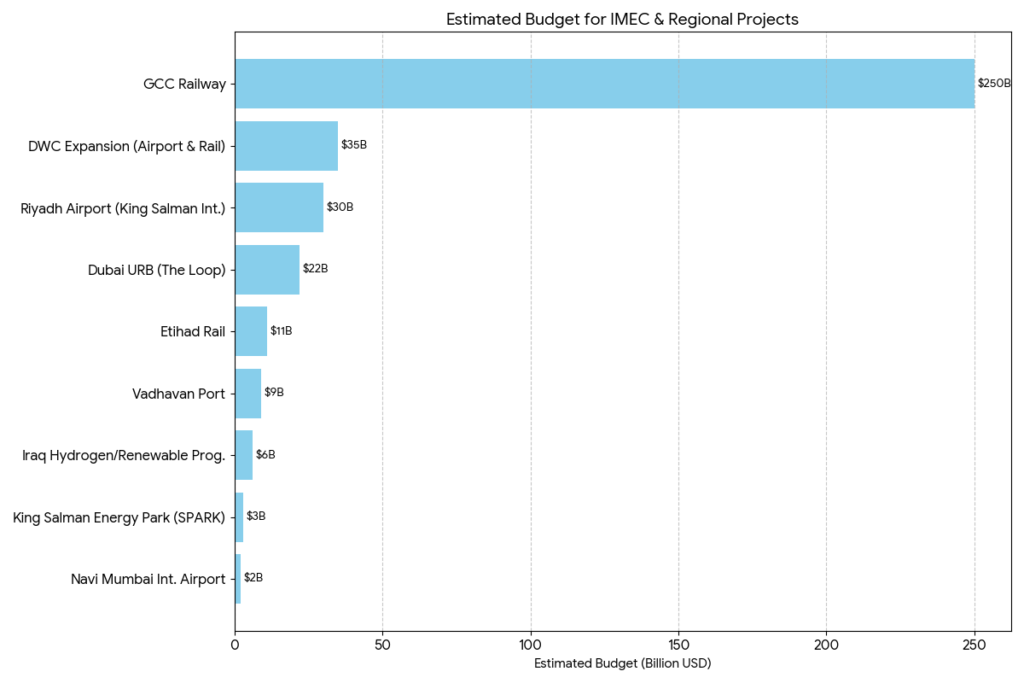
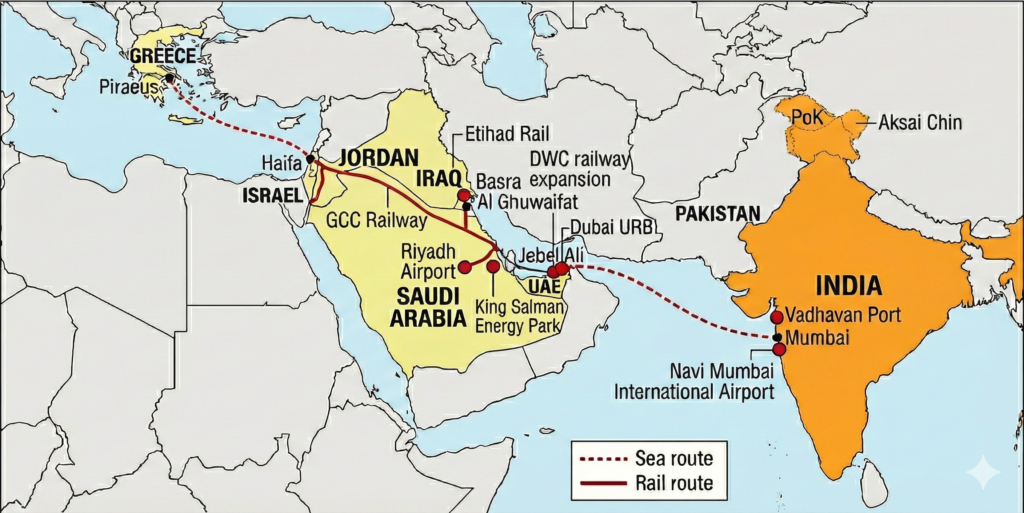
If we look at the starting point of IMEC, which is India, it has been developing the critical infrastructure on its western part, which directly contributing the perspective of IMEC on goods, services, and people. We can see the development of the Vadhavan Port in Palghar, Maharashtra, as a strategic “Mother Port”, which costs around $10 billion. Designed to rank among the world’s top 10 ports, its natural deep draft will allow it to accommodate the globe’s largest container ships, vessels that most existing Indian ports cannot currently handle. This critical infrastructure aims to serve as the primary gateway for exports bound for Europe and the Middle East, effectively acting as the maritime launchpad for future trade routes like IMEC.
To alleviate critical congestion at Mumbai’s saturated Airport, the Navi Mumbai International Airport, which costs around $2.4 billion, is being built as a massive greenfield aviation hub. it features dual parallel runways capable of simultaneous independent operations, a significant upgrade over the city’s current infrastructure. With an ultimate capacity to handle 90 million passengers annually, NMIA is strategically positioned to anchor the economic rise of the “Third Mumbai” and seamlessly integrate with key connectivity projects like the Mumbai Trans Harbour Link.
Etihad Rail
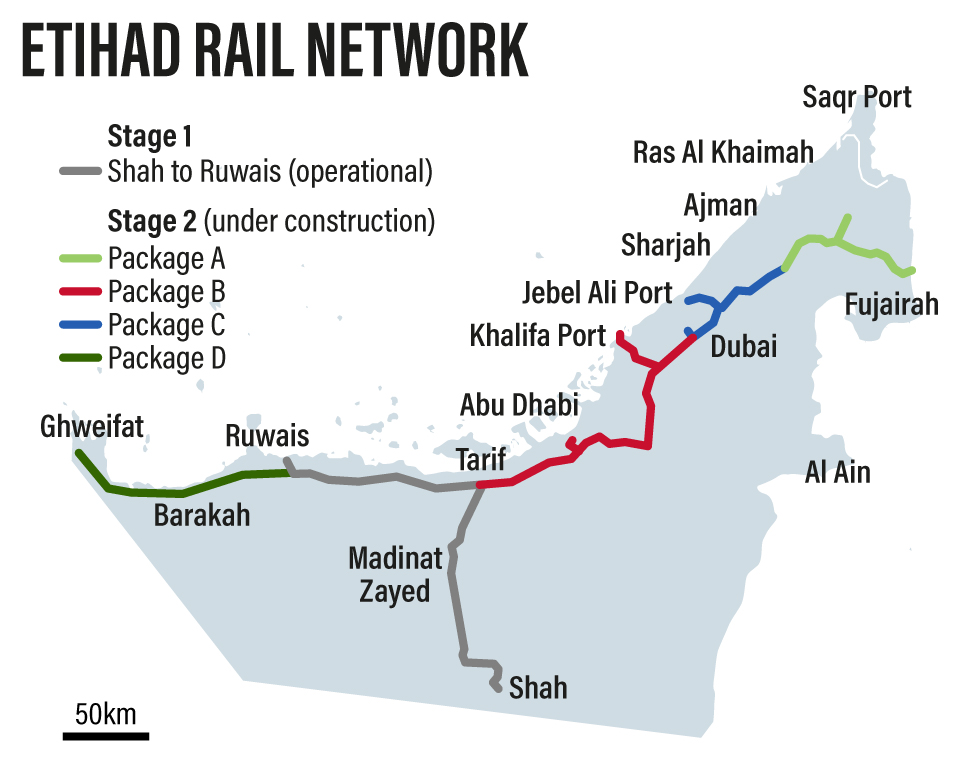
Etihad Rail is no longer a concept; it is an operational infrastructure. The 900-kilometer network now connects all seven emirates, linking the trade hubs of Fujairah, Abu Dhabi, and Dubai to the end of the Saudi border at Ghuweifat. This is the physical “spine” of IMEC. By actively moving freight today and in the future, it is also preparing to launch passenger services in 2026. The UAE has effectively built its leg of the corridor before the treaty ink was even dry. It proves that the “rail” in the ship-to-rail concept isn’t missing, it’s just waiting for the other stakeholder to plug in.
DWC railway expansion
The most critical “multimodal” link in the entire IMEC corridor is currently being forged at the Al Maktoum International Airport (DWC). This isn’t just a normal airport expansion; it is the creation of a “Rail-Air Spine.” The confirmed integration of Etihad Rail into the DWC infrastructure means that for the first time, goods arriving by air can be seamlessly transferred to rail cars without touching the public road. This eliminates the “multiple handling” inefficiency problems. By 2030, this hub will be capable of processing 12 million tonnes of cargo annually, effectively silencing the argument that air-to-rail logistics are too complex to work.
Riyadh airport
Saudi Arabia isn’t just watching; it is building a challenger that elevates the whole IMEC concept. The King Salman International Airport is designed to be a massive logistics “aerotropolis” spanning 57 square kilometres. With six parallel runways and a capacity for 120 million passengers by 2030, it aims to capture the east-west transit market. For IMEC, this is vital because it creates a second major logistics node in the desert. It ensures that the corridor isn’t dependent on a single point of failure; if Dubai is the maritime gateway, Riyadh is positioning itself as the air-cargo distribution engine for the Northern Gulf.
King Salman Energy Park
This 50-square-kilometer industrial city is the engine room where the region’s energy transition is being manufactured. It is the world’s first industrial city to receive LEED Silver certification, focusing on capturing the full value chain of energy, which ranges from drilling technology to digital services. By connecting SPARK directly to the future GCC railway, Saudi Arabia is ensuring that the goods flowing along the IMEC aren’t just imports from India or Europe, but high-value industrial exports “Made in Saudi Arabia,” giving the railway a commercially viable two-way payload.
GCC Railway
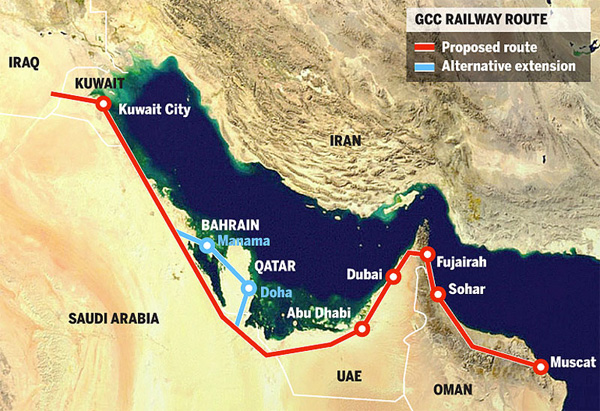
The GCC Railway is the “missing link” that turns isolated national tracks into a regional network. After years of delays, the political will has finally solidified, with the Saudi-Qatar link approved in late 2025 and the UAE-Oman “Hafeet Rail” moving into construction. This project stitches together the economies of six nations, creating a unified customs and logistics zone like the Schengen zone in Europe. Once this network is active, the “IMEC” route doesn’t just end in Saudi Arabia; it instantly connects the markets of Kuwait, Qatar, Bahrain, and Oman, exponentially increasing the corridor’s economic catchment area.
Quiet Logic behind IMEC Silence
Every era of global trade has had its visible highways and its hidden backroads. The visible ones dominate maps, headlines, and history books, until they don’t. The hidden ones grow quietly, shaped by necessity rather than ambition. IMEC belongs firmly to the second category.
At first glance, IMEC appears stalled by wars, rival corridors, funding hesitations, and technical complications. Yet beneath this apparent inertia lies a subtler truth: nations are no longer waiting for grand multilateral consensus to secure their respective economic futures. They are building independently, hedging silently, and aligning later. IMEC is not a single corridor under construction; it is a convergence waiting to snap into place.
The instability of the Middle East, often cited as IMEC’s death sentence, may paradoxically be its justification. Supply-chain shocks, energy weaponization, and chokepoint politics have taught states a hard lesson: efficiency without resilience is fragility. IMEC is the physical manifestation of that lesson. It prioritizes optionality over optimization, alternatives over monopolies. What makes IMEC uniquely modern is that it does not demand loyalty. Countries can participate without committing fully, benefit without antagonizing rivals, and prepare without provoking confrontation. This ambiguity is not a flaw; it is a survival strategy in an era of fractured globalization.
When historians look back, they may not mark IMEC’s birth by a treaty or summit. They may instead trace it through port capacities expanded, rails connected, airports repositioned, and energy corridors diversified. By the time the world agrees on what IMEC is, it may already be functioning. The most dangerous assumption today is that what cannot be seen cannot reshape the system. Shadow corridors have a habit of becoming dominant routes precisely because no one notices them until it’s too late.